How Long Is the Great Wall of China, and Why Nobody Agrees on the Number
- August 22, 2026
- China Travel , how long is the great wall of china
Ask how long is the Great Wall of China and you will get three different answers depending on who is counting. That is not sloppiness. It is the honest consequence of the fact that the Great Wall was never one wall, was never built by one dynasty, and in many places was never really a wall at all.
Most visitors arrive expecting a single continuous ribbon of stone, the version that appears on posters. What exists is closer to a two-thousand-year archaeological sprawl of ramparts, watchtowers, beacon platforms, ditches and repurposed cliff faces, built and abandoned and rebuilt by a dozen different regimes with completely different enemies in mind.
The Official Number, and What It Includes
In 2012 China's State Administration of Cultural Heritage published the result of a multi-year archaeological survey and put the total at 21,196.18 kilometres, roughly 13,171 miles. That figure counts everything: every dynasty, every branch, every parallel run of wall, plus trenches and natural barriers that were incorporated into the defensive line.
An earlier survey, published in 2009, measured only the Ming dynasty sections and arrived at 8,851.8 kilometres, about 5,500 miles. That is the wall most people mean when they picture it, the brick-and-stone version built between the fourteenth and seventeenth centuries. So both numbers are correct. They are simply answering different questions, and the reason the Great Wall of China resists a single measurement is that its definition keeps moving.
How Long It Took to Build
The short answer to how long did it take to build the Great Wall of China is around two thousand years, which is also a slightly misleading way to put it, because nobody worked on it continuously. Fortified earthen walls went up among rival states as early as the seventh century BC. After unification in 221 BC the Qin linked and extended several of them. The Han pushed a line west to protect the Silk Road corridor. Then came long centuries when the whole idea was abandoned as expensive and ineffective.
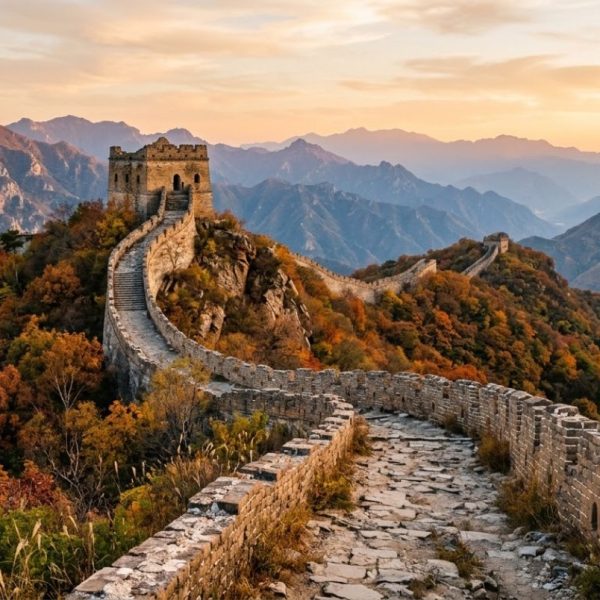
The Ming revived it seriously after a series of military humiliations, and it is their engineering, brick-faced, wide enough to march on, studded with signal towers, that survives in the photogenic form tourists visit. UNESCO inscribed the complex as a World Heritage Site in 1987, and its listing covers structures spread across fifteen provinces rather than any single monument.
No, You Cannot See It From Space
The claim that the wall is visible from space predates spaceflight by decades, which should have been the first clue. It is not true in the way people mean it. The wall is long but rarely more than a handful of metres wide, and it is built from local material that matches the surrounding terrain almost perfectly.
Astronauts in low Earth orbit have repeatedly reported being unable to pick it out with the unaided eye, and China's first astronaut said the same after his 2003 flight. Under exceptional conditions, with a camera and a long lens and low sun angle throwing shadows, sections have been photographed from orbit. That is a different thing from seeing it, and it is worth knowing before you repeat the line to a guide.
Which Section to Actually Walk
This matters more than the statistics. Badaling, closest to Beijing and heavily restored, is the default and is often shoulder to shoulder with people. Mutianyu is also restored but sits further out, has a cable car, and gives you room to breathe. Jinshanling is the one experienced travellers recommend, partly restored and partly weathered, with a long ridge walk and genuine solitude on a weekday.
Then there is Jiankou, unrestored, crumbling and photographed constantly by people who probably should not have been there. It is genuinely dangerous in places. Admire the pictures and go to Jinshanling.
Nobody agrees on the length of the Great Wall because the answer depends entirely on what you decide to count. Publishing has its own version of that argument, since the sales figures attributed to celebrity book clubs shift depending on whether you count the pick itself or everything the author sold afterwards. Influence is easy to feel and hard to measure.
Disagreement over the Wall's length is really a disagreement about definitions, which is a very old kind of problem. Anyone who has read a little philosophy for beginners will recognise it immediately: settle what counts as the thing before arguing about how much of it there is. The measuring tape was never the difficulty.
The Best Time to Visit China
For the wall specifically, and for most of the country, the best time to visit China is spring or autumn. April into May brings mild air and green hills. September into October gives clear light and the best photographs of the year. Summer is hot, hazy and busy, and the first week of October is a national holiday when domestic travel volumes make everything harder.
Winter is the underrated option. It is genuinely cold on an exposed ridge, but the air is sharp, the crowds thin out, and snow on the towers is the version most photographers actually want.
The Practical Layer Nobody Mentions
Independent travel in China has become far easier, but it is still a country where the details reward preparation. Payment runs almost entirely through mobile apps, ticketing for popular sections is timed and booked in advance, and English signage thins out quickly once you leave the main tourist corridors.
Language is the part people underestimate. Chinese is unusually compact, and as this look at text compression in Chinese translation explains, the same information takes up dramatically less space than in English, which is why machine-translated signage and menus so often read as clipped or ambiguous. Carry an offline translation app and screenshot your hotel address in characters before you need it.
It is also worth remembering how much of Asian tourism now flows in the other direction. The spending power of chinese tourists has reshaped destinations across the region, and the infrastructure you benefit from as a visitor to China exists largely because domestic travel there operates at a scale nothing else matches.